FIELD NOTES · RETAIL & OUTDOOR · OCT. 13, 2026
THE HIKING BOOM VASQUE DIDN’T SURVIVE
Download PDFView the carouselAlso on LinkedIn ↗
At a Glance
- Vasque, the Minnesota-based, Red Wing-owned brand behind the iconic Sundowner hiking boot, shut down in October 2024 after 60 years in business.
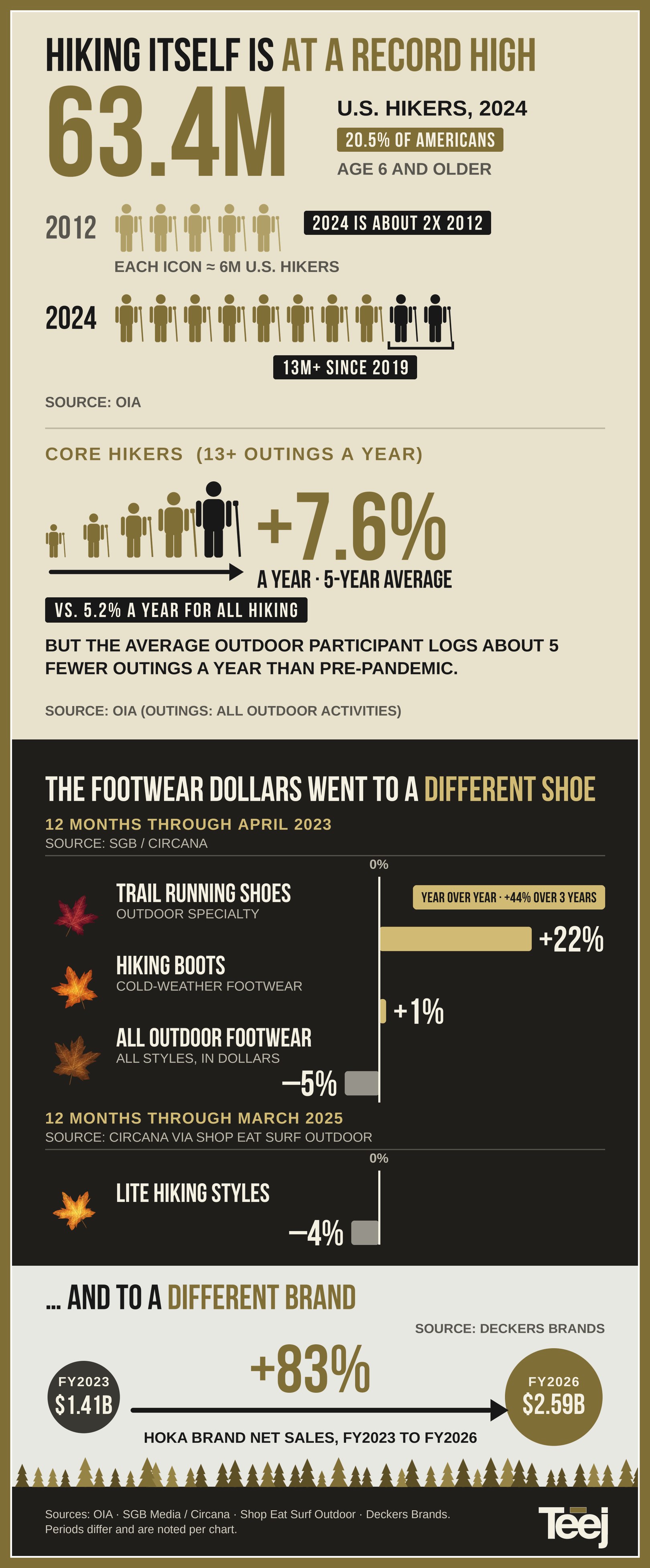
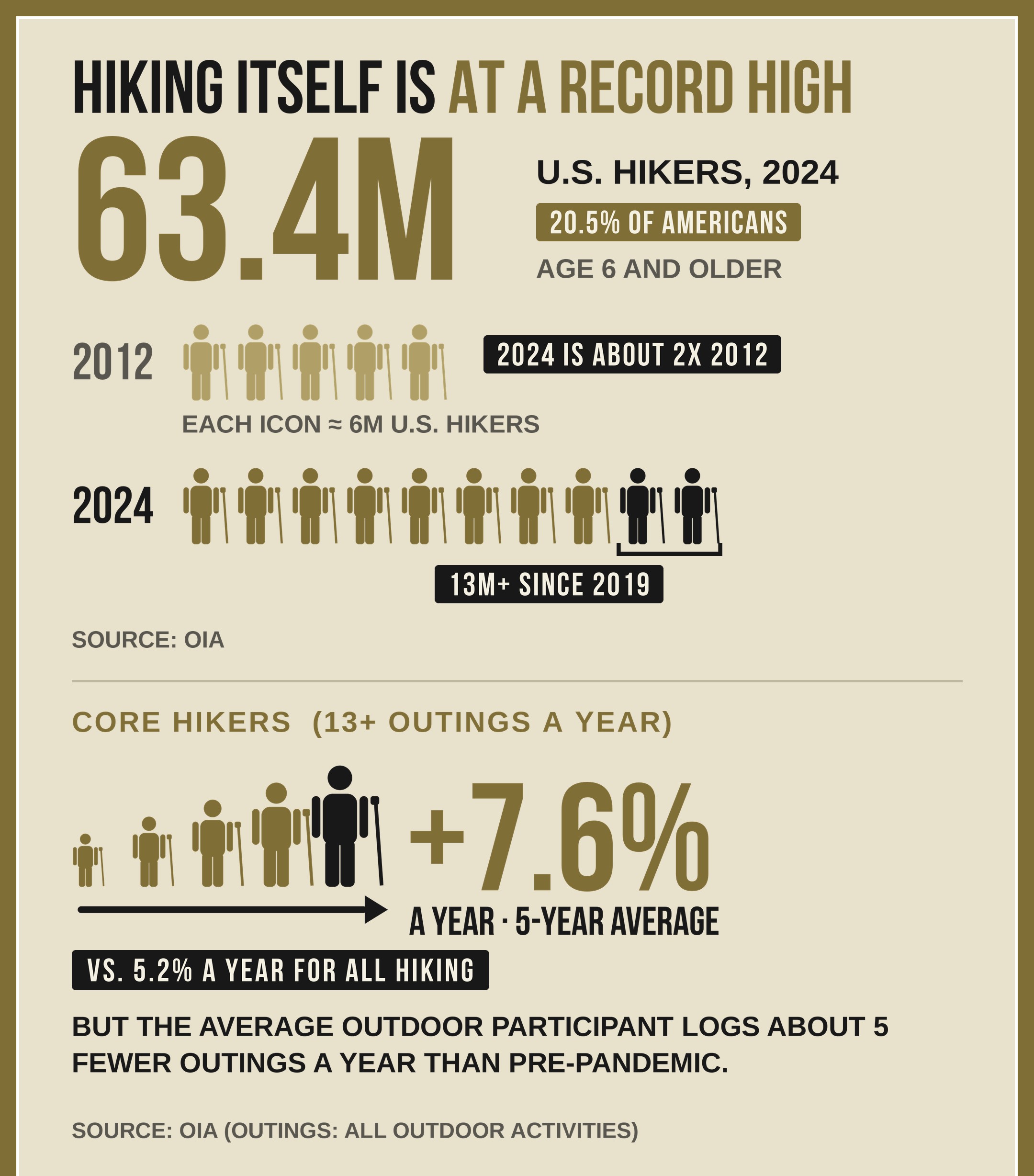
- The closure came as hiking hit a record high: 63.4 million Americans went hiking in 2024, nearly double the number in 2012.
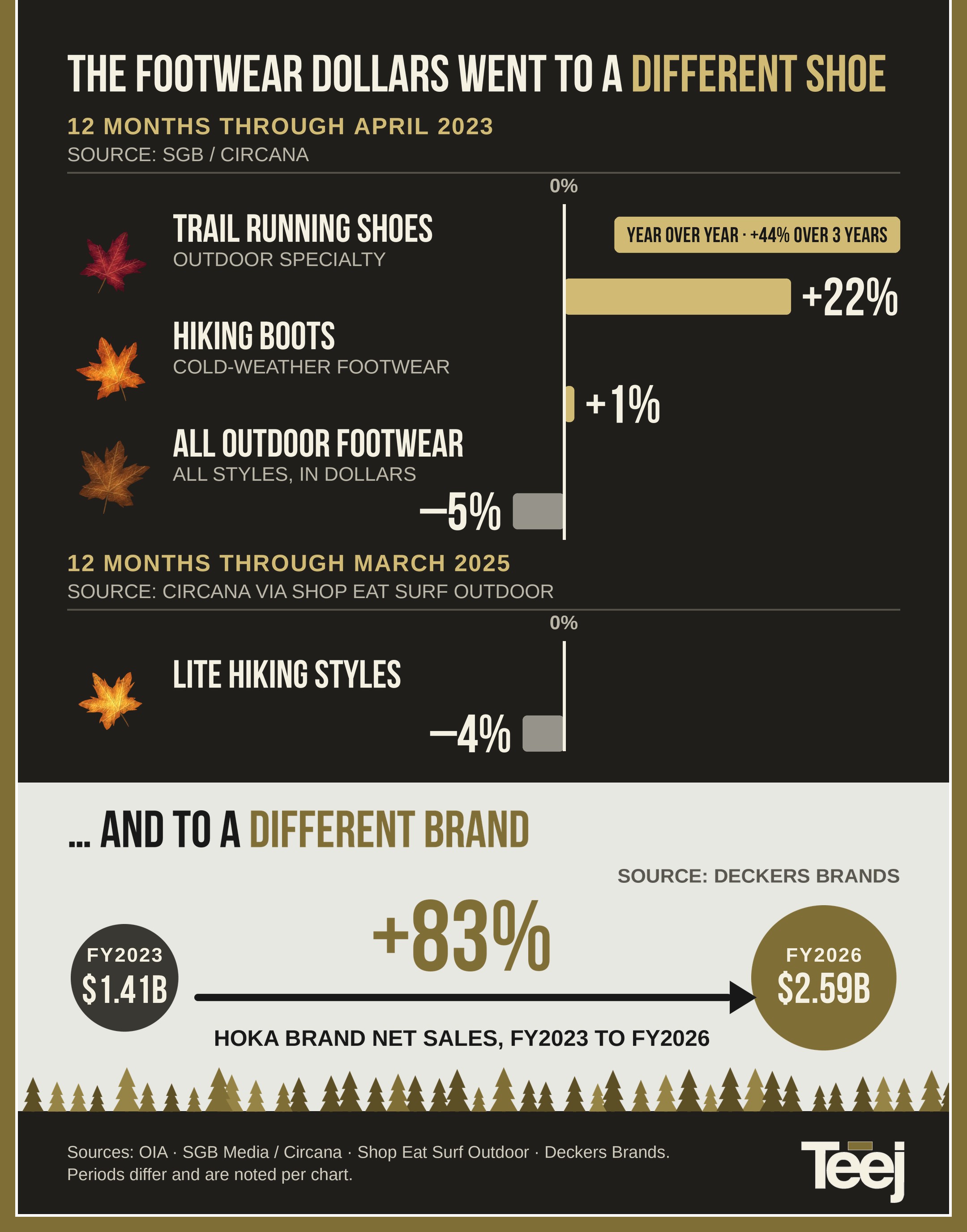
- Vasque’s decline was not about hikers losing interest. Footwear dollars shifted toward lighter, trail-running-style boots; Hoka’s net sales grew 83 percent from fiscal 2023 to fiscal 2026.
- A fast-growing resale and repair market, projected to reach $78.8 billion by 2030, suggests Vasque’s durability-first approach may have been ahead of its time rather than behind it.
- The National Park Service’s maintenance backlog topped $22 billion in 2024, a sign that trail use is outgrowing the infrastructure and brands built to support it.
Key Questions
How does a 60-year-old boot brand fail in the middle of a record hiking boom?
If hikers didn’t leave the trail, where did the footwear dollars go?
Was Vasque’s durability-first instinct wrong, or just early?
A Boot I Couldn’t Replace
Not long ago, this Minnesotan went looking to replace my favorite pair of hiking boots. I wear men’s size 13M, and I could not find a single pair of Vasque Sundowners anywhere. Not at a retailer or on Vasque’s own site. I ended up with a pair of Vasque’s newer Breeze LT NTX instead, a different boot built around a dissimilar idea of comfort. It turns out I wasn’t failing at a search. Vasque, the brand that made the Sundowner, no longer exists.
That’s the strange part. According to the Outdoor Industry Association, a record 63.4 million Americans went hiking in 2024, nearly double the number in 2012. That is more than 13 million above the 2019 level. Hiking has grown 5.2 percent a year on a five-year average. Hikers are going out less often, though: the average outdoor participant now logs about five fewer outings a year than before the pandemic, according to the association. Yet the most committed hikers, those who go out 13 or more times a year, have grown 7.6 percent a year on a five-year average. Most of the hikers who picked it up during the pandemic have stuck with it. More people are on the trail than ever, and staying there. One of the boots that helped build that trail still didn’t survive it.
The strain shows up off the trail, too. The National Park Service’s deferred-maintenance backlog: the unfunded repairs piling up on trails, bridges, and facilities. It grew from roughly $13 billion in 2020 to more than $22 billion by January 2024, even as the agency logged a record 331.9 million visits that year while absorbing a 9 percent staffing cut, according to Federal Times and the National Parks Conservation Association. Leave No Trace, the main group teaching low-impact practices, released its 2025 annual report, which showed about 19,000 complete online courses and outreach to another 26,000 people through its 2025 state-advocate events. Real numbers, but a rounding error against 63.4 million hikers. Participation is scaling faster than stewardship capacity.
From the Alps to Red Wing, Minnesota
Vasque started in 1964, not as an acquisition but as Red Wing Shoe Company’s own answer to a trend it saw building overseas. Company chairman William Sweasy had noticed the hiking-boot culture building around the Italian Alps and decided to bring that style to the U.S. himself, according to Red Wing Shoe Company’s company history and the outdoor blog Red Clay Soul. The line launched under the name “Voyaguer,” built on Italian lasts and developed with input from hikers and climbers who field-tested the boots.
The Sundowner became the brand’s signature: full-grain leather, a stiff shank, a fit that needed almost no break-in. I loved them and sold plenty of them on a retail floor, in a life before this one, and the fit was the whole pitch. Snug through the heel, no slipping, and boots that felt broken-in on day one.
What the Boot Actually Did
Reviewers on the gear site Trailspace who wore the Italian-made Sundowners for years describe a tight, narrow fit that “saved me from more than a few sprained ankles,” and a boot that needed close to zero break-in compared with almost anything else on the wall.
My memories of them are more specific: they felt like they rolled you forward, heel to toe, almost propulsive on flat ground. I’ve never seen that described as a formal design feature in anything Vasque published, so I’ll call it what it is - my own impression, not a spec sheet claim. But it lines up with something real: a turned-up heel and an easy forefoot flex are the two ingredients of what’s now called a rocker sole, a geometry that reduces load on the Achilles and helps the foot roll through a stride, according to the footwear-research site Doctors of Running. If the old Sundowner had that shape, my flat feet and I were feeling it decades before Hoka made rocker geometry a mainstream selling point.
Then the Boot Changed Under Everyone
Sometime in the early 2000s, Vasque moved Sundowner production from Italy to China. Reviewers who had worn both versions were blunt about the difference: thinner leather, longer break-in and, as one put it on the retail site Sierra, a boot that “just doesn’t feel right out of the box.” Production later moved again to Vietnam. When Vasque reintroduced the Sundowner in 2015, it paired Red Wing’s own tannery leather with Vietnam-built construction. Boot reviewers on Trailspace said it felt stiffer than the Italian original.
By 2010, Vasque’s own leadership was already naming the deeper problem out loud, telling the industry blog Alister & Paine: “The outdoor industry started going light and fast, switching from bulky gear to lighter weight while we kept making these burly brown backpacking boots.”
The Numbers Don’t Blame the Hikers
Red Wing’s public explanation for closing Vasque, given to the trade publication SGB Media, was that “consumers have shifted from traditional hiking activities to a broader set of casual outdoor activities.” The participation data does not support the first half of that sentence. Hiking itself is at a record high. What shrank was demand for the specific product Vasque kept building. People didn’t leave the trail. They left this boot behind.
October 2024
Red Wing announced it would sunset Vasque on Oct. 11, 2024, after what it described as three straight years of flat sales, saying there was “no viable path forward” for the brand, according to Gear Patrol and Gear Junkie. The company said it would refocus on its core brands (Red Wing, Irish Setter, and WORX) and keep the Vasque website running for a while so remaining inventory could sell through. Sixty years after Sweasy brought an Italian trend to Minnesota, the brand he started was gone.
What Replaced It
The boots on my feet now are Vasque’s Breeze LT NTX. Considerably lighter, foam-cushioned, comfortable within the first few steps in a way the old Sundowner never was on day one. It’s a good boot. It’s also a completely different theory of what a hiking boot should feel like: comfort delivered immediately, like a pair of running shoes, instead of comfort, durability, and rock-solid ankle safety earned across miles.
The Durability Comeback Vasque Missed
There is a real market case that Vasque’s timing was backward. The U.S. secondhand apparel market is projected to reach $78.8 billion by 2030, growing roughly 7.3 percent a year. In 2025 alone, it grew nearly four times faster than the broader retail clothing market, according to Retail Dive. Red Wing’s own resole shop, the kind of repair infrastructure (welt construction, etc.) Vasque never built out around the Sundowner, can restore about 15,000 pairs of boots a year, and even that is not enough: Demand outstrips capacity, and customers now wait weeks to get boots back, the Republican Eagle reported. Buyers are telling the market they want gear that can be repaired and resold, not just replaced.
Policy is starting to catch up to that instinct. California’s Responsible Textile Recovery Act, signed the same month Red Wing announced Vasque’s closure, is the first U.S. law requiring producers of clothing and footwear to fund and run their own take-back, repair and recycling systems, with deadlines running through 2030 and fines up to $50,000 a day for noncompliance, according to the law firm Holland & Knight. Product end-of-life is becoming serious business. Right-to-repair laws elsewhere in the U.S. are still limited to electronics and appliances. Europe’s Right to Repair Directive does not reach footwear either, so California’s law is a leading edge. Not yet a norm, but it points to where expectations are heading for products built to be re-soled for years rather than replaced every season.
The materials story is less tidy than the leather-versus-synthetic instinct suggests. One published lifecycle analysis found a leather safety boot’s manufacturing footprint (18.65 kg CO2e) was actually lower than a Gore-Tex hiking boot’s (27.1 kg CO2e), according to the journal MDPI Sustainability. Yet the leather carries its own upstream cost: Separate research on finished leather attributes roughly two-thirds of its climate impact and water use to cattle farming itself, before a hide ever reaches a tannery, the sustainability site Carbonfact reported. A shanked leather boot built to be re-soled for a decade and a foam-midsole boot built to be replaced every few hundred miles are not making the same bet. The real tradeoff is between fewer, repairable products and more disposable ones. But neither material comes out with a clean environmental win once the whole supply chain is considered.
Earlier this year, at Outdoor Retailer, I stopped by the Red Wing booth. Not for a lead on anything, just the same curiosity that has followed me since I worked on the retail floor. I asked what happened to Vasque. The answer echoed the core brand messaging and everything above: The market had moved, and no version of the boot was built to move with it.
It is tempting to read Vasque’s exit as tragically mistimed; shutting down a heritage durability brand just as brands like Filson and Carhartt were enjoying a heritage-workwear resurgence, and just as the resale market kept compounding. Red Wing’s own announcement gestured at this tension: Even while citing Vasque’s flat sales, coverage of the closure noted that competitor Hoka had posted 30 percent year-over-year net sales growth that same quarter, according to Gear Patrol. Proof that the hiking-footwear dollars had not disappeared; they had just moved to a different kind of boot. But the data does not fully support a clean “durability was about to win” story either: Market forecasters still expect the hiking and trail footwear category to keep growing through “premiumization” built on lightweight, tech-driven materials, not a swing back to heavy leather construction, according to the research firm Technavio. The more honest read may be that Vasque was not caught between two eras so much as standing still in both. Never light enough to chase Hoka, and by the end, no longer distinctly durable enough to own the case above.
Sixty years is a long run for any brand. This one didn’t end because people stopped hiking. It ended because the boot that started it never quite caught up to where hiking went.
Why It Matters
- Participation isn’t the same as provider success. A category can hit record highs while a specific, well-known product inside it quietly dies. Growth in hiking says nothing about whether any single hiking-boot brand is fine.
- This was a shift toward convenience, not from durability. Vasque’s decline tracks the market moving toward out-of-the-box comfort, not hikers losing interest in boots built to last.
- The resale data complicates the obvious takeaway. A resale and repair market growing toward $78.8 billion by 2030 suggests Vasque’s durability-first instinct may have been timed wrong, not aimed wrong.
- Record trail use is outpacing the infrastructure built to support it. The National Park Service’s backlog and Leave No Trace’s outreach numbers show a strain that goes well beyond any one brand.
- Legacy brands fail for standing still, not for having history. Vasque’s problem wasn’t tradition itself; it was failing to update its answer to who the boot was for.
About the Author
Teej Thaldorf is a strategic partner and product manager with more than 10 years in consumer products and retail, focused on account growth, digital wholesale, merchandising and forecasting. Early in his career he worked in outdoor retail at REI and Eastern Mountain Sports. He sold Vasque boots in the 1990s and still wears the brand today. Based in Bloomington, Minnesota, he writes about how brands win and lose shelf space. Connect with him on LinkedIn or at thaldorf.com.
References
- Red Wing Shoe Company — History
- Vasque Boots, and a Giveaway — Red Clay Soul
- Revamping the Vasque Brand — Alister & Paine, 2010
- Vasque Sundowner GTX Reviews — Trailspace
- Remember the old Italian made Vasque boots? — Sierra
- Iconic Vasque Brand Discontinued by Parent Red Wing — SGB Media
- An Iconic Hiking Brand Is Being Shuttered — Gear Patrol
- Vasque Going Out of Business — GearJunkie
- 2026 Hiking Report — Outdoor Industry Association
- Circana: Spring U.S. Outdoor Sales Pressured By Footwear And Equipment Weakness — SGB Media
- Circana Details Top Outdoor Sellers — Shop Eat Surf Outdoor
- Deckers Brands FY2026 Results
- Deckers Brands FY2024 Results
- Footwear Science: Rocker Soles — Doctors of Running
- National Parks Need $22 Billion to Address Growing Maintenance Backlog — Federal Times
- National Park Service Sets Visitation Record Amid Historic Staffing Cuts — NPCA
- 2025 Annual Report — Leave No Trace
- Red Wing Shoe Ramps Up Repair Services Amid Soaring Demand — Republican Eagle
- US Resale Market to Surpass $78 Billion by 2030 — Retail Dive
- A Closer Look at California’s Responsible Textile Recovery Act — Holland & Knight
- Life Cycle Assessment of Footwear — MDPI Sustainability
- The Carbon Impact of Leather — Carbonfact
- Hiking and Trail Footwear Market to Grow by USD 8.43 Billion, 2025-2029 — Technavio
© 2026 Teej Thaldorf · thaldorf.com